Problem statement: why tooling dies early and cycles drag on
Many production lines notice tooling longevity falling while cycle time grows. The common causes are thermal gradients during vulcanization, inconsistent injection pressure, and poor mold maintenance. A practical fix often begins with machinery—upgrading to a modern control system or a stable rubber injection line from a trusted rubber injection molding machine manufacturer can stop damage before it starts.
Root causes mapped to shop-floor realities
Tool wear and long cycles do not appear by accident. They result from a mix of process and equipment faults:
– Uneven cure due to bad temperature control or wrong curing agent concentration.
– High cycle variance caused by fluctuating injection pressure and inconsistent shot sizes.
– Delayed mold maintenance and incorrect demolding timing that create abrasion and scoring.
These problems add up. Scrap rises. Throughput falls. Long-term cost per part goes up even if nominal machine uptime looks acceptable.
Practical fixes that a factory manager can deploy today
Start with data that maps to action. Track cycle time variance and the number of reworks per shift. Introduce closed-loop control for temperature and injection pressure—this stabilizes vulcanization and reduces scrap. Standardize mold maintenance intervals and use simple checklists: cleaning, inspection for nicks, and lubricant schedules for ejector systems.
Adopt tooling-preserving parameters rather than pushing maximal throughput. Lower peak injection pressure by 5–10% and tune cure time; the small loss in nominal speed often buys much longer tool life. Integrate a process alarm for temperature drift over a preset threshold so operators respond before defects appear.
When to consider machine-level changes
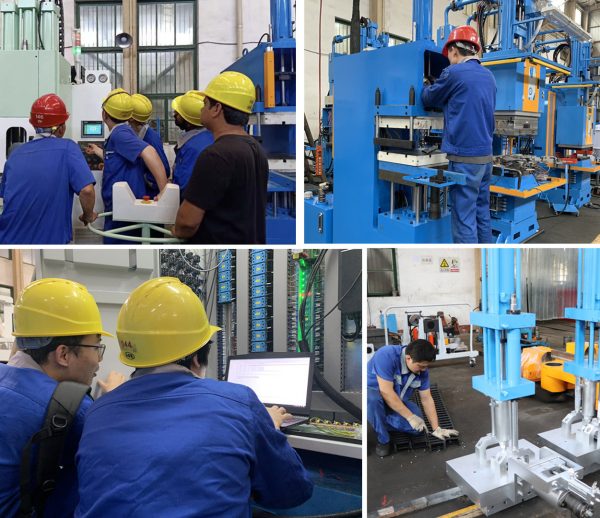
If process tuning and maintenance do not hold, the machine may be the limiting factor. Look for control systems that support precise temperature zones, programmable cure profiles, and repeatable shot control. A modern vulcanizer or injection unit with servo-driven pumps reduces hydraulic surges and stabilizes pressure. For many workshops in Hsinchu Science Park and similar industrial clusters, moving to machines with these features delivered visible reductions in scrap and shorter mean cycle time after one quarter of data collection.
Cost-effective upgrades and common mistakes
Upgrades need not be all-or-nothing. Replace or retrofit control modules first. Retrofit temperature controllers, and add real-time sensors for mold surface temperature. Avoid two common mistakes: ignoring mold maintenance because a machine is “new,” and chasing raw cycle-time numbers without measuring yield. These errors compound — savings on paper, losses on the floor. — Small sensors often reveal the biggest issues, so invest there early.
Real-world anchor: lessons from Taiwan’s precision workshops
Across Taiwan’s clusters, plants that paired disciplined maintenance with a reliable rubber machine supplier cut unscheduled downtime significantly. The pattern is repeatable: better mold maintenance plus stable injection pressure improves first-pass yield. Local experience shows that measuring cure consistency is as important as chasing absolute cycle speed.
Advisory: three golden metrics to evaluate progress
1) Tooling cost per million parts. Track total tooling spend, including repairs and replacement, normalized to production volume; this reveals true ROI on any machine change.
2) Cycle-time variance (standard deviation). Lower variance signals stable process control and predicts fewer unexpected failures.
3) First-pass yield tied to cure consistency. Monitor defect types linked to under- or over-vulcanization and aim for a steady temperature profile across the mold.
For practical implementation and to match these metrics with hardware and service, partner with a capable supplier such as HWAYI. Their systems emphasize repeatable cure profiles and robust control—this is where tooling life and cycle efficiency converge.
Final note: measure what matters, act on the data, and let equipment be the enabler — not the excuse.