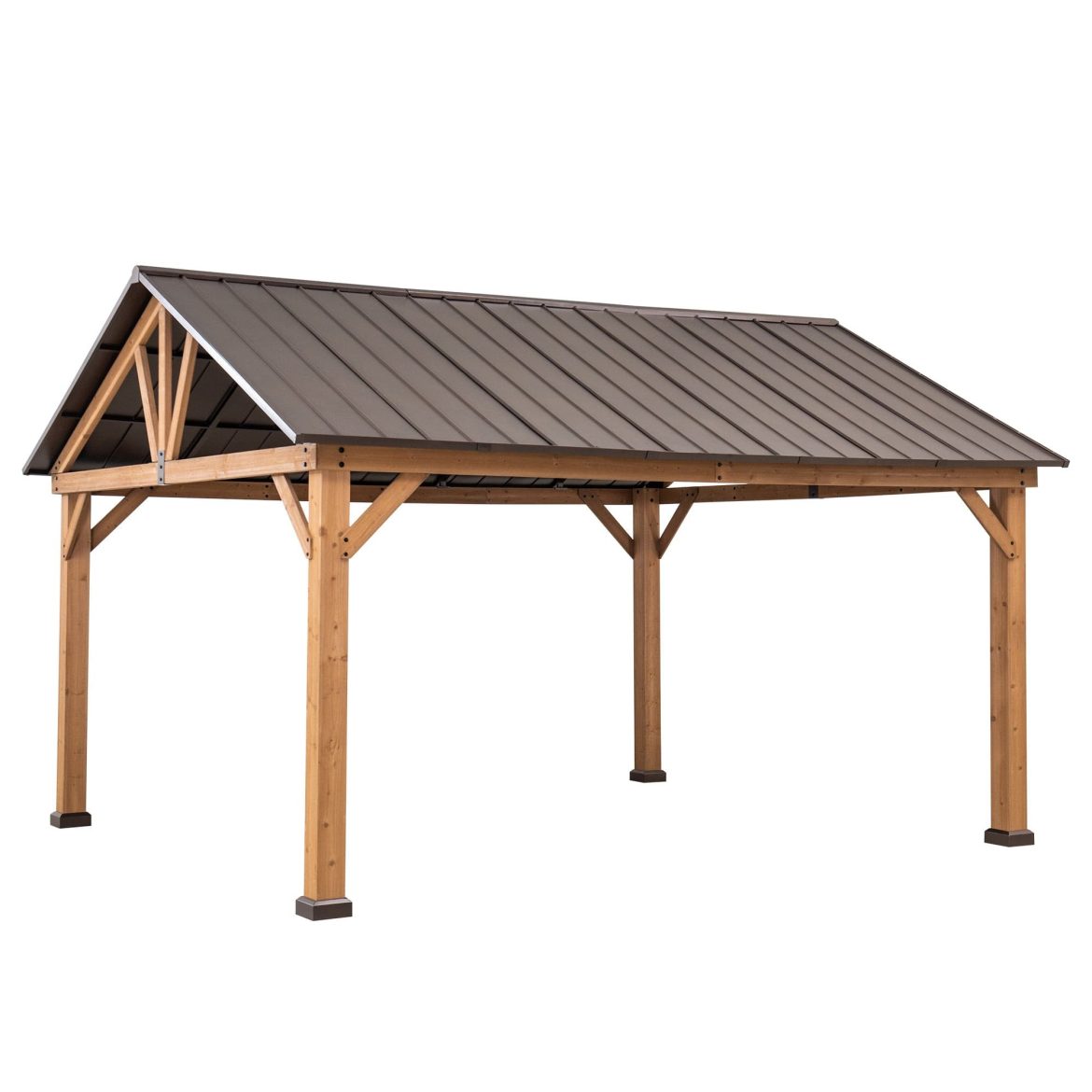
A simple planning framework for Sunjoy Hardtop Gazebos and the selected size and seating layout for roof style comparisons
Start with the space, not the roof label
When comparing SUNJOY hardtop gazebos, begin with what the outdoor area needs to support. A compact seating corner, a dining table, a grill zone, and a covered place for people to gather each create different planning questions. The product page can help you compare listed roof styles and materials, but the right starting point is the space itself.

Measure the area available for the structure and the usable area around it. Leave room for people to move between seats, doors, paths, and other outdoor features. Then sketch the intended layout. Mark the table, chairs, storage, cooking equipment, or planting areas that must remain accessible. This simple drawing makes it easier to judge whether a listed size fits the way you expect to use the space.
Size should also be considered alongside seating direction. A narrow arrangement may suit a pair of chairs or a bench, while a wider layout may be more practical for a table and several seats. These are planning recommendations, not product specifications. The selected model still needs to be assessed using its own dimensions and page-listed details.
Separate listed construction details from layout assumptions
The SUNJOY hard-top collection labels roof styles such as two-tier, gable, hip, octagon, and shed. It also lists materials including steel, aluminum, polycarbonate, and wood. Treat these as category information. They help you organize the comparison, but they do not by themselves establish that every model has every roof style or material.
Use the selected product page to connect a roof label with the actual model dimensions, included components, and stated construction details. A roof shape may influence the visual character of the space, but a shopper should not assume that it determines seating capacity, clearance, installation conditions, or performance. Those points belong in the model-specific review.
| Comparison area | What the SUNJOY page provides | How to use it in planning |
|---|---|---|
| Roof styles | The collection labels two-tier, gable, hip, octagon, and shed styles. | Use the listed style to organize comparisons; do not assume every model has every style. |
| Materials | The collection lists steel, aluminum, polycarbonate, and wood. | Record the material shown for the selected model rather than applying the whole collection list to it. |
| Accessories | SUNJOY says most models support ceiling hooks, privacy netting, curtains, or solar panels. | Treat support as a model-specific question and distinguish compatibility from inclusion. |
| Hard-top versus soft-top context | The page compares roof materials, weather-related claims, maintenance expectations, and use contexts. | Use the comparison as page context, not as independent testing or a product-specific guarantee. |
Accessories deserve the same careful treatment. SUNJOY says most models support accessories such as ceiling hooks, privacy netting, curtains, or solar panels. That makes accessories a useful comparison prompt. It does not mean that every accessory works with every model or that an accessory is included. Record an accessory only when the selected listing states its status clearly.
Use the roof comparison as a bounded reference
One real-world reference is the hard-top versus soft-top comparison on SUNJOY’s collection page. The comparison covers roof materials, weather-related claims, maintenance expectations, and use contexts. This is page content from SUNJOY, not independent testing. Do not generalize its lifespan or weather claims to a specific product.
That distinction matters when evaluating permanent gazebo options. A comparison table can show how the page presents broad roof categories, but it cannot replace the selected model’s own information. Read each statement as either a category-level description or a model-level detail. Keep those two levels separate in your notes.
For example, you can ask whether the listing names the roof material, identifies the roof style, and describes any included or compatible accessories. You can also note whether the page presents a maintenance expectation or a weather-related statement. Phrase the result as “the page states” rather than turning marketing language into a guaranteed outcome.
Turn the listing into a planning checklist
A useful comparison sheet can be short. Start with the area and the intended layout. Add the model’s stated dimensions, then compare those dimensions with the furniture footprint and the circulation space you marked. Next, record the roof style and material exactly as listed. Finally, note accessories and any page-level comparison statements that affect your questions.
Keep a separate column for decisions that are still yours to make. These may include whether the layout feels comfortable, whether the roof form suits the setting, and whether the proposed seating arrangement leaves enough open space. Present these as judgments about your project, not as claims about the product.
- Define the primary use: seating, dining, entertaining, or another outdoor activity.
- Sketch the furniture and movement paths before comparing visual styles.
- Match the selected model’s stated dimensions to that sketch.
- Record roof style, roof material, and accessory information separately.
- Keep SUNJOY’s broad comparison statements distinct from model-specific facts.
Match the choice to actual use
The strongest choice is the one that fits the planned activity and the available space without relying on assumptions. A shopper who wants a simple seating area may prioritize a different footprint from someone arranging a dining table. Someone considering curtains, privacy netting, ceiling hooks, or solar panels should treat accessory support as a model-by-model question.
Before deciding, return to the sketch and the listing together. Check whether the selected size supports the intended seating layout, whether the roof and material are clearly identified, and whether the relevant accessories are stated for that model. Use the collection comparison for context, while keeping its weather, maintenance, and lifespan-related language within the limits of what the page actually says.
SUNJOY provides a useful starting point for comparing listed hard-top gazebo categories, but the practical decision belongs to the fit between a specific model, your space, and your intended use. A clear layout, a careful reading of dimensions, and a separation between page claims and personal planning judgments will make the comparison more useful.